Reconstructive and Female Urology in Dhaka
Repair for a narrowed urethra, a damaged ureter, or a urinary fistula, and practical help for women living with urine leakage.
Some urinary problems cannot be fixed with medicine. They need part of the urinary tract to be repaired or rebuilt. Dr. Humayun Kabir Kallol, an experienced Urologist in Dhaka, offers reconstructive urology services at Continental Hospital PLC, Gulshan-2, with a particular interest in urethroplasty and fistula repair.
- MBBS
- FCPS (Surgery)
- MS (Urology)
BM&DC Reg. No. A-45623
 Posted on Google

 Sajib Rana
Trustindex verifies that the original source of the review is Google.
আমার দেখা বেষ্ট একজন ডাক্তার। আমি নিজে অপারেশন করিয়েছি আলহামদুলিল্লাহ উনি খুব সুন্দরভাবে আমার অপারেশন করিয়ে দিয়েছে। সবথেকে বড় কথা পেশেন্টের সাথে উনার আন্ডারস্ট্যান্ডিং খুবই ভালো। আমার আম্মু, মামা আমার এক আঙ্কেলের অপারেশনে উনি নিজে করিয়েছে এবং খুব ভালো ভাবেই করেছে। আলহামদুলিল্লাহ এখন পর্যন্ত সব ঠিক আছে। সবকিছু মিলিয়ে আমার দেখা সবথেকে ভালো ইউরোলজিস্ট স্যার। ❤️Posted on Google TIPU SULTANমাশা আল্লাহ।Posted on Google
 Rubayet AminThis was my first experience with surgery, as I recently underwent a kidney stone removal procedure (PCNL) under Dr. Humayun Kabir Kallol at Continental Hospital. Naturally, I was a bit nervous, but Dr. Kallol made the entire experience much easier and more comfortable than I had expected. He is extremely knowledgeable, smart, friendly and approachable. What I appreciated most was his genuine care for his patients. He was always available on WhatsApp whenever I experienced any discomfort after the surgery, and he was even kind enough to call me personally to check on my recovery. It's rare to find a doctor who makes you feel this comfortable and cared for, not just during treatment but even after the procedure. I am truly grateful to him for making my first surgical experience a positive one. Highly recommended to anyone looking for a skilled and compassionate urologist.Posted on Google
 Golam MostofaExcellent 👌Posted on Google
 A K M Borhan ChowdhuryDr Humayun Kabir is clear communicator, patient, and truly cares about the outcome. He is very respectful of my time. Highly recommended!Posted on Google
 Mufasser SheikhDr. was really so kind & friendly. It was a free feeling after even very first visit.Posted on Google
 Mimucha MimHe is a very good doctor. When I talk to him, the patient recovers a lot. His operations are always successful. I have been taking treatment from him for many years. He is a very good doctor and a good person.Posted on Google
 Nazia SultanaDr. Humayun Kabir Kollol Sir is very professional, caring, and helpful. He performed my surgery with great care. I’m truly grateful for his treatment and support. Highly recommended!
What Is Reconstructive Urology?
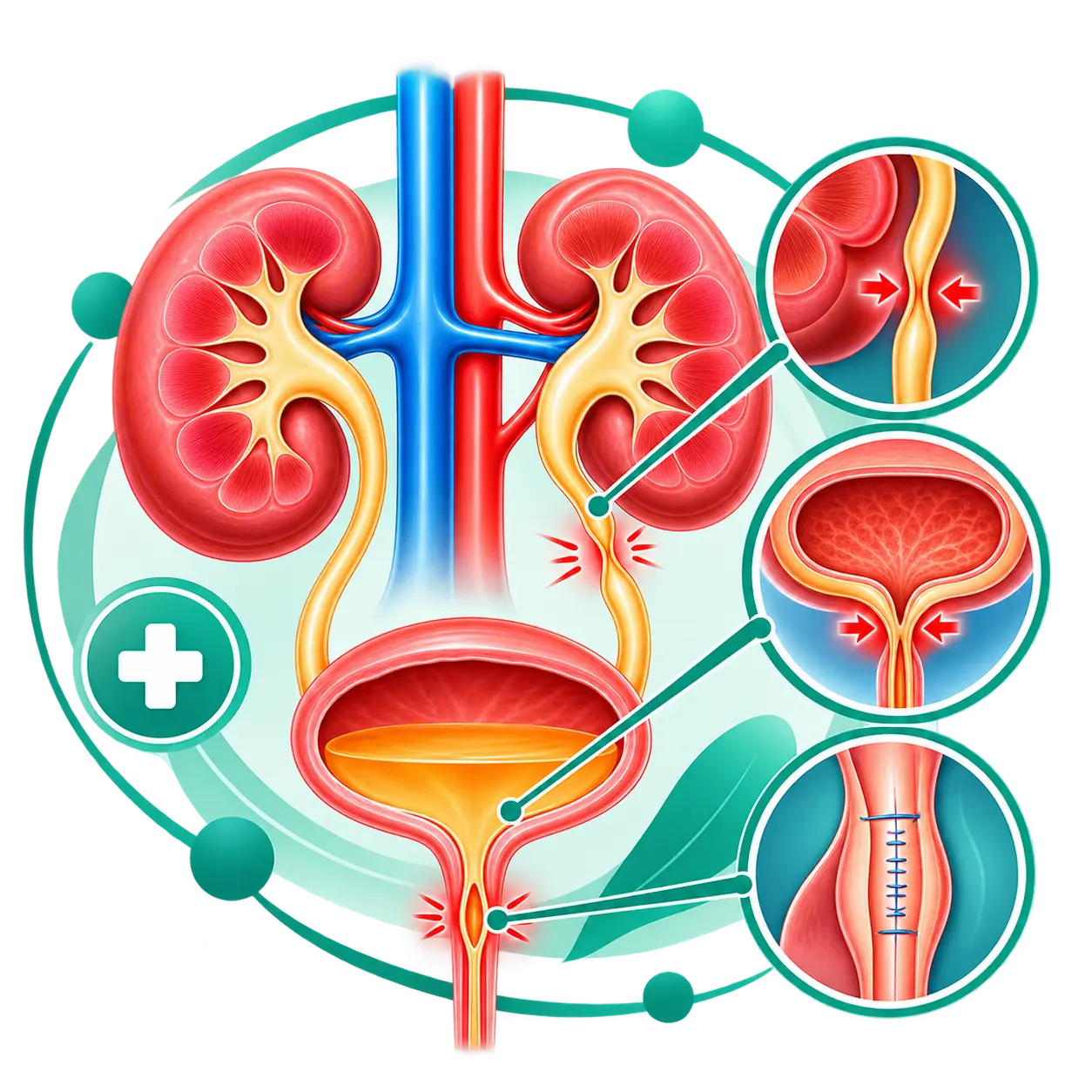
Reconstructive urology is surgery that repairs or rebuilds parts of the urinary tract damaged by scarring, injury, previous surgery, or radiotherapy. Common examples are urethroplasty for a narrowed urethra, reimplanting the ureter into the bladder, and closing a fistula between the bladder and vagina.
Female urology overlaps with this work. It covers urinary problems specific to women, from leakage and a narrowed urethra to fistulas that develop after childbirth or gynaecological surgery.
This page covers both areas. The table shows where each condition is explained.
Reconstructive Urology
Urethral stricture in men
Urethroplasty, including buccal graft repair
Ureteric reimplantation and ureter repair
Female Urology
Vesicovaginal and ureterovaginal fistula
Female urethral stricture
Urinary incontinence (urine leakage)
Urethral Stricture Treatment
A urethral stricture is a narrowing of the urine channel caused by scar tissue. Urine has to push through a tighter passage, so the stream becomes slow, thin, or split.
Common Causes
- A fall astride a hard object, such as a bicycle bar or a drain edge
- Pelvic fractures from road accidents
- A previous catheter, telescope procedure, or prostate operation
- Past infections of the urethra
- Skin conditions such as lichen sclerosus
In many men, no clear cause is ever found.
Symptoms to Watch For
A weak or spraying stream, straining to pass urine, dribbling, and repeated urine infections are typical. Some men only find out when they suddenly cannot pass urine at all.
These symptoms can look a lot like an enlarged prostate. The two need very different treatment, which is why testing comes first. Prostate-related problems are explained on our prostate treatment page.
How a Stricture Is Assessed
A urine flow test shows how slow the stream is. A retrograde urethrogram (RGU), sometimes with an MCU, uses X-ray dye to show exactly where the narrowing is and how long it is.
Stricture length and position are the two facts that decide the treatment. A short scope test may also be used to look inside the urethra.
Why Repeated Dilatation Rarely Solves the Problem
Many men in Bangladesh have their stricture stretched (dilatation) or cut from the inside with a telescope (optical urethrotomy or DVIU) again and again. Relief often lasts only months.
International guidance explains why. Urethrotomy or dilatation is reasonable as a first step for a short stricture, about 2 cm or less, in the bulbar urethra. Used this way, it succeeds in roughly half of patients.
If the stricture comes back, repeating the same procedure is unlikely to work, and it can make the scar longer. At that point, urethroplasty is the recommended option, with success rates of up to 90 to 95 percent in experienced hands.
Urethroplasty Surgery
Urethroplasty repairs the urethra in open surgery, rather than stretching or cutting the scar. The type depends on the length and position of the stricture.
01
Anastomotic Urethroplasty
For a short stricture, the scarred segment is removed and the two healthy ends are stitched together. This approach has some of the highest long-term success rates in urology.
02
Buccal Mucosal Graft (BMG) Urethroplasty
For a longer stricture, removing the scar would leave too big a gap. Instead, the narrow segment is widened with a graft, a thin strip of lining taken from the inside of the cheek.
Cheek lining is used because it is naturally used to a moist environment, heals well, and leaves no visible scar on the face. The cheek usually feels sore for a week or two.
03
Recovery After Urethroplasty
A catheter stays in while the repair heals, usually for around two to three weeks. An X-ray dye test is often done before it is removed, to confirm the repair is watertight.
Follow-up flow tests continue afterwards, because strictures can recur even after successful surgery, though far less often than after urethrotomy.
Ureteric Reimplantation and Ureter Repair
The ureter is the tube that carries urine from the kidney to the bladder. Its lower part can be narrowed or injured, sometimes during gynaecological or abdominal surgery.
In ureteroneocystostomy, the damaged lower end is removed and the healthy ureter is reattached to the bladder. Dr. Kallol performs this laparoscopically, along with anterior transposition of the ureter in selected cases. Read about how laparoscopic urology surgery works.
Protecting the kidney is the main goal. A ureter left blocked for too long can permanently damage the kidney above it.
Female Urology: Urinary Fistula Repair
A vesicovaginal fistula (VVF) is an abnormal opening between the bladder and the vagina. Urine leaks through it into the vagina, day and night, without control.
In Bangladesh, fistulas can follow prolonged or obstructed labour. They also occur after hysterectomy, caesarean section, or radiotherapy for cervical cancer.
A ureterovaginal fistula (UVF) is similar, but the opening is between the ureter and vagina. Women with UVF often leak constantly but still pass urine normally as well.
A Fistula Is Not Your Fault
Many women live with a fistula for years, out of embarrassment or because they believe nothing can be done. Constant leakage affects work, prayer, marriage, and self-confidence.
A fistula is a medical injury, not a personal failing, and most fistulas can be repaired. Seeking help is the right step, however long it has been.
How Fistulas Are Repaired
Repair can be done through the vagina, through the abdomen, or laparoscopically. The route depends on the fistula’s size, its position, and whether the ureter is involved.
Laparoscopic repair of vesicovaginal and ureterovaginal fistulas is an area of particular experience for Dr. Kallol. This includes fistulas after hysterectomy and the more difficult fistulas that follow radiotherapy. He has shared a recorded laparoscopic repair of a post-hysterectomy VVF on his YouTube channel.
A catheter usually stays in for about two weeks after repair to let the bladder heal. Radiation-related fistulas need more planning, because the surrounding tissue heals more slowly.
Female Urethral Stricture
A narrowed urethra is less common in women and is often missed. Symptoms such as a slow stream, straining, and repeated infections are easily put down to other causes.
Many women receive repeated dilatation for years. When the narrowing keeps returning, female urethroplasty can offer a longer-lasting solution. Dr. Kallol performs urethroplasty for female urethral stricture.
Urinary Incontinence Treatment for Women
Urine leakage is very common in women, especially after childbirth and around menopause. It is not an inevitable part of ageing, and treatment helps most women.
Type
Stress incontinence
Urge incontinence
Mixed incontinence
What Happens
Leakage with coughing, sneezing, laughing, or lifting
A sudden, strong urge, with leakage before reaching the toilet
Both of the above
What Happens
Supervised pelvic floor exercises for at least 3 months
Bladder training, fluid and caffeine changes, then medicine if needed
Treat the most troublesome part first
Pelvic floor exercises work best when taught properly and done regularly. NICE recommends a supervised programme of at least three months as the first treatment for stress or mixed incontinence.
If leakage still affects daily life after this, anti-incontinence surgery can support the urethra and reduce stress leakage. Dr. Kallol explains which option suits your type of leakage.
Constant leakage, day and night, is different. It can be a sign of a fistula rather than ordinary incontinence and should be checked promptly.
Consulting a Urologist as a Woman
Many women feel hesitant about discussing urinary problems with a male doctor. That is understandable.
You are welcome to bring a female family member to your consultation and to ask for a female attendant during any examination. Questions are answered privately, and nothing is examined without your consent.
Many of the conditions on this page are treated by urologists for women of all ages. Talking openly is the first step toward a solution.
Experience in Reconstruction and Fistula Surgery
Reconstructive surgery depends on careful planning and precise technique. Dr. Kallol’s training in general surgery, followed by an MS in Urology at NIKDU, gave him a strong base for this type of work.
Over five years at Dhaka Medical College Hospital, he treated many patients referred with complex strictures and fistulas. His current practice includes anastomotic and BMG urethroplasty, female urethroplasty, laparoscopic ureteric reimplantation, and laparoscopic fistula repair.
You can read about his training and professional background.
Frequently Asked Questions
Can a urethral stricture be treated without surgery?
A short stricture can sometimes be treated with dilatation or urethrotomy, but these succeed in only about half of patients. If the stricture returns, urethroplasty gives a much higher chance of lasting success.
What is the success rate of urethroplasty?
In experienced hands, urethroplasty succeeds in up to 90 to 95 percent of patients, depending on the stricture’s length, position, and previous treatments. Short strictures repaired by anastomotic urethroplasty have the highest success.
What is buccal mucosal graft urethroplasty?
It is a repair for longer strictures, where the narrow urethra is widened using a thin graft taken from the inside of the cheek. The cheek heals on its own within a few weeks and leaves no visible scar.
How long is the catheter needed after urethroplasty?
Usually around two to three weeks. An X-ray dye test is often done before removal to check that the repair has healed.
Can a vesicovaginal fistula be repaired after hysterectomy?
Yes. Fistulas after hysterectomy are among the more common types and can often be repaired, including laparoscopically. The approach depends on the fistula’s size and position.
Can a fistula be repaired after radiotherapy?
Yes, though it is more complex because radiation affects how tissues heal. These repairs need careful timing and planning by a surgeon experienced in fistula surgery.
What treatments help urine leakage in women?
Supervised pelvic floor exercises for at least three months are the first treatment for stress leakage. Bladder training and medicine help urge leakage. Surgery is considered if these do not help enough.
Is constant urine leakage the same as incontinence?
Not always. Leakage that never stops, day and night, may be caused by a fistula. It should be checked by a urologist, because a fistula needs surgical repair rather than exercises or medicine.
Do women get urethral strictures?
Yes, though less often than men. Female urethral stricture is frequently missed. Women who need repeated dilatation may benefit from female urethroplasty.
Can I bring a family member to my consultation?
Yes. Women are welcome to bring a family member and to request a female attendant during any examination.
Book a Consultation
If a narrowed urethra keeps coming back, or leakage is affecting your daily life, a specialist review can show what is realistically possible. Many people wait years before asking. It is never too late to seek help.
Please bring previous RGU or MCU reports, operation notes from any earlier dilatation, urethrotomy, hysterectomy, or fistula repair, and your current prescriptions.