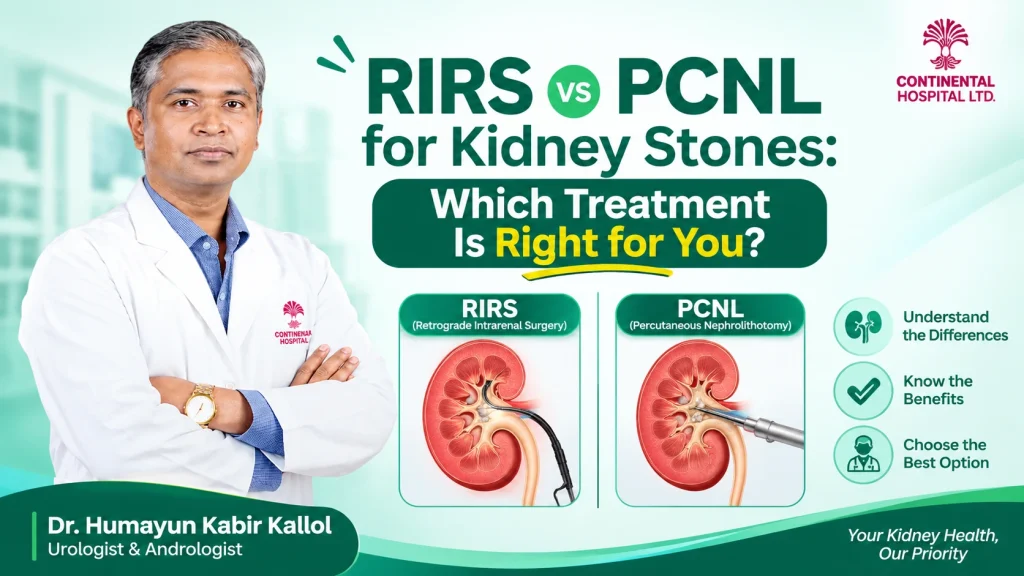
A kidney stone diagnosis usually arrives with a flood of unfamiliar letters: RIRS, PCNL, ESWL, URS. If your scan report mentions a stone large enough to need surgery, your urologist will likely be weighing two keyhole options in particular, RIRS and PCNL. Both clear stones without a large incision, but they are built for different situations, and understanding the difference will make your consultation far more useful.
What RIRS and PCNL Actually Mean
RIRS stands for Retrograde Intrarenal Surgery. A thin, flexible telescope is passed up through the urethra and bladder, into the ureter, and up into the kidney itself. There is no cut on the skin at all. Once the surgeon can see the stone, a holmium laser fiber is threaded through the scope and used to break the stone into dust or small fragments that either pass naturally or are retrieved with a tiny basket.
PCNL stands for Percutaneous Nephrolithotomy. Instead of going in through the urinary tract, the surgeon creates a direct, roughly one-centimetre channel through the skin of the back straight into the kidney. A rigid instrument then goes down that channel to break up and remove the stone. It sounds more invasive than RIRS because there is a visible puncture site, but for the right stone, it is often the faster and more complete option.
According to the Kidney Stone Treatment page published by Dr. Humayun Kabir Kallol, RIRS is generally the approach used for stones sitting inside the kidney that can be reached with a flexible scope, while PCNL is reserved for larger or “staghorn” stones that fill a significant part of the kidney’s collecting system, often clearing them in a single session.
How the Two Procedures Compare
| Factor | RIRS | PCNL |
| Access | Through the natural urinary tract, no skin incision | Through a small ~1 cm puncture in the back |
| Best suited for | Stones generally under about 2 cm inside the kidney | Larger or staghorn stones filling the kidney |
| Typical hospital stay | Often a single overnight stay | Usually two to three days |
| Recovery | Generally quicker, less post-operative discomfort | Slightly longer, with more soreness at the access site |
| Stent needed? | Often yes, temporarily, especially if the ureter is narrow | Sometimes, depending on how the kidney drains afterward |
Neither procedure is simply “better” in the abstract. The choice depends on stone size, stone location, kidney anatomy, and whether there has been prior surgery in the area. This is a decision a urologist makes after reviewing your imaging, not something to self-select based on which name sounds less intimidating.
Why Your Urologist Might Recommend One Over the Other
On the practice’s own kidney stone treatment page, several situations are described where surgery, rather than watchful waiting or medication, becomes the recommended path: when the stone is too large to pass on its own, when pain cannot be controlled with painkillers, when urine flow is blocked, when infection keeps coming back, or when a reasonable waiting period has passed without the stone moving.
If imaging shows a single, moderate-sized stone sitting in an accessible part of the kidney, RIRS is frequently the first option discussed, since it avoids a skin incision entirely. If the stone is large, branching through multiple areas of the kidney, or has resisted previous treatment attempts, PCNL tends to be favoured because it can clear a large stone burden more completely in one go.
What If the Ureter Is Too Narrow for RIRS?
Sometimes the ureter, the tube connecting the kidney to the bladder, is too narrow to pass the flexible scope comfortably on the first attempt. In that case, a temporary stent may be placed to gently widen the passage, and the stone-clearing procedure is completed in a second session roughly two weeks later. This is a normal, planned part of care rather than a complication, though it understandably frustrates patients hoping for a single visit.
Recovery After Each Procedure
After RIRS, many patients go home the next day. Mild burning when urinating, occasional light blood in the urine, and a dull ache on the treated side are common for a few days, especially if a stent is in place. After PCNL, the hospital stay is usually a little longer, the puncture site needs normal wound care, and activity is restricted for a slightly longer period while the kidney heals. Both procedures are done under anaesthesia, and your care team will give you specific instructions on fluids, activity, and follow-up imaging.
Warning Signs That Need Urgent Attention
Whether you are waiting for surgery or recovering from it, certain symptoms should never be “watched” at home. Seek emergency care immediately if you experience fever or shivering alongside stone pain, pain that painkillers cannot control, repeated vomiting that prevents you from keeping fluids down, or very little to no urine output. A fever combined with a blocked kidney is treated as an emergency, and the usual first step is draining the kidney with a stent or thin tube before the stone itself is addressed.
Preventing Stones From Coming Back
Kidney stones have a frustrating habit of recurring. The practical steps that come up again and again, both on the practice’s own stone treatment page and in general urology guidance, are straightforward: drink enough water to produce pale urine, generally around 2.5 to 3 litres a day; keep salt intake to about 6 grams daily; maintain a normal, not reduced, calcium intake unless your doctor advises otherwise; and limit fizzy drinks. None of these replace a metabolic work-up if stones keep recurring, but they are a reasonable starting point most people can act on immediately.
Choosing Between RIRS and PCNL: What to Bring to Your Consultation
If you are heading into a urology consultation to discuss surgical options, it helps to bring your imaging reports (ultrasound or CT), a list of any prior stone episodes or surgeries, your current medications, and a clear description of your symptoms and their timeline. The more complete this picture is, the more precisely your urologist can match the procedure to your specific stone rather than a general rule of thumb.
Frequently Asked Questions
Is RIRS more painful than PCNL?
Most patients report less post-operative discomfort after RIRS than after PCNL, largely because there is no skin incision. However, pain tolerance varies, and both procedures are performed under anaesthesia with pain control managed afterward. Discuss expected discomfort and pain management with your surgical team beforehand.
Can a kidney stone come back after RIRS or PCNL?
Yes. Clearing an existing stone does not prevent new ones from forming. Hydration, moderate salt intake, and addressing any underlying metabolic cause (where identified) are the main tools for reducing recurrence, as outlined above.
How do I know which procedure is right for my stone?
This depends on stone size, location, and your overall kidney anatomy, all of which your urologist assesses from your imaging. There is no reliable way to determine this from symptoms alone, which is why imaging and an in-person consultation are necessary before any surgical decision is made.
What happens if the stone is too big for either procedure in one session?
Very large or complex staghorn stones sometimes require a staged approach, combining PCNL with a second procedure, or occasionally a laparoscopic approach as described on the laparoscopic urology surgery page. Your surgeon will explain the planned approach based on your specific imaging.
Final Thoughts
RIRS and PCNL are both effective, minimally invasive ways to clear kidney stones, and the right choice depends entirely on the size, location, and complexity of your stone as seen on imaging. If you are dealing with stone pain, recurring infections, or a stone that imaging shows is unlikely to pass on its own, the next step is a proper evaluation. You can review the full range of stone treatment options on the Kidney Stone Treatment page, learn more about Dr. Humayun Kabir Kallol’s background on the About page, or find chamber hours and appointment details on the Contact page.
Medical Disclaimer
This article is for general educational purposes only and is not a substitute for professional medical advice, diagnosis, or treatment. It does not recommend any specific treatment for any individual reader. Every case is different, and only a qualified urologist who has examined you and reviewed your test results can advise on what applies to your situation. Always seek the advice of a physician or other qualified health provider with any questions you may have regarding a medical condition, and never disregard professional medical advice or delay seeking it because of something you read here.