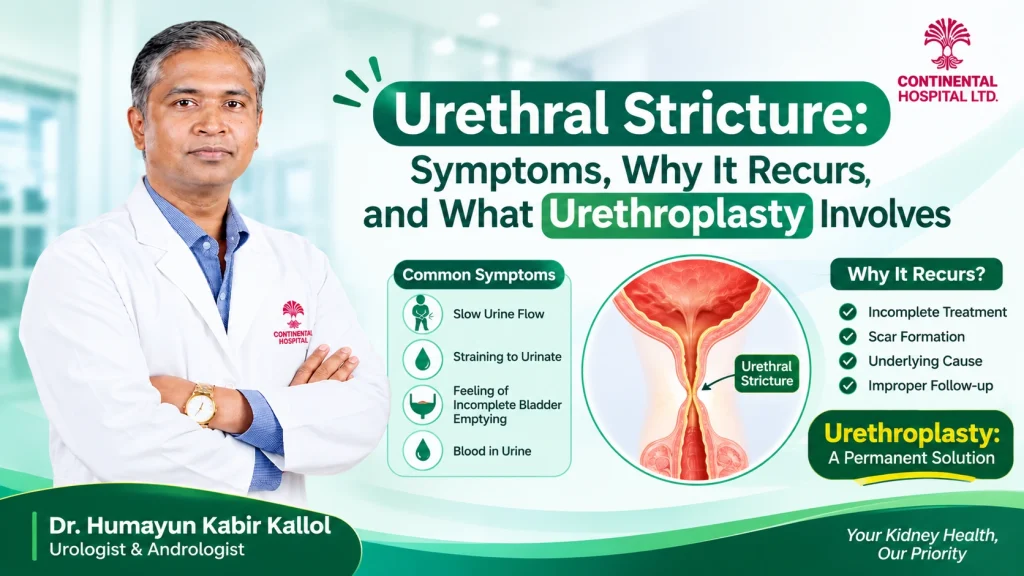
If you have had a weak urine stream for months, been treated with a quick in-office dilation that helped for a while and then stopped working, you may be dealing with a urethral stricture rather than an ordinary case of an enlarged prostate. The two can look similar from the outside, which is exactly why they’re easy to confuse and why testing matters before treatment starts.
What a Urethral Stricture Is
MedlinePlus describes a urethral stricture simply as an abnormal narrowing of the urethra, the tube that carries urine out of the body from the bladder. According to the Reconstructive Female Urology page on Dr. Humayun Kabir Kallol’s website, which also covers male urethral stricture, the narrowing is usually caused by scar tissue. That scarring can follow a fall or pelvic fracture, a prior catheter or prostate procedure, infection, or certain skin conditions. In a meaningful number of cases, the page notes, no clear cause is ever found.
Symptoms to Watch For
- A weak or split urine stream
- Straining to urinate
- Dribbling after urination
- Repeated urinary tract infections
- In some men, a sudden, complete inability to pass urine
Because these symptoms overlap heavily with BPH, testing comes first in almost every case. Guessing based on symptoms alone risks months of the wrong treatment.
Why Short-Term Fixes Often Don’t Last
The Reconstructive Female Urology is candid about a common pattern: short strictures may initially be treated by stretching (dilation) or cutting from inside the urethra, and this can bring quick relief. The problem is that this relief is frequently temporary, because the scar tissue that caused the narrowing in the first place tends to re-form. Patients often go through this cycle more than once before a more durable solution is discussed.
Urethroplasty: The More Durable Option
When strictures keep recurring after dilation or internal cutting, urethroplasty is typically the next step. This is reconstructive surgery that removes or reroutes the scarred segment of urethra, using healthy tissue, sometimes from elsewhere in the body, to restore a wider, more durable channel for urine flow.
The practice’s own page states a success rate of up to 90 to 95 percent “in experienced hands” for urethroplasty. This is a figure published by the practice itself, not an independently audited statistic, and outcomes always depend on stricture length, location, prior treatments, and individual anatomy, which is why this number should be discussed directly with your surgeon rather than treated as a guarantee.
What Recovery Typically Involves
After urethroplasty, a urinary catheter usually stays in place for a period while the reconstructed area heals, with a follow-up test (often an X-ray study while urinating) to confirm healing before the catheter is removed. Activity restrictions during this healing window are standard, and your surgical team will give you specific guidance based on the type of urethroplasty performed.
Related Conditions Worth Knowing About
The same service page also covers conditions that sometimes get confused with, or occur alongside, urethral problems. Urinary incontinence in women (leakage with coughing or sudden urges) is usually treated first with pelvic floor exercises and bladder training before surgery is considered. Urinary fistula, an abnormal opening between the bladder or ureter and the vagina, causes continuous leakage rather than the stress- or urge-related leakage typical of ordinary incontinence, and is treated differently, sometimes with vaginal, abdominal, or laparoscopic repair as described on the Laparoscopic Urology Surgery page.
When to Seek Care
MedlinePlus advises contacting a healthcare provider as soon as symptoms of urethral stricture appear, noting that prompt treatment may help avoid complications affecting the kidneys or bladder. If you suddenly cannot pass urine at all, this is an emergency requiring immediate medical attention rather than a scheduled appointment.
Frequently Asked Questions
Why did my stricture come back after dilation?
Dilation widens the narrowed segment mechanically, but it doesn’t remove the scar tissue causing the narrowing. That tissue often re-forms over time, which is why recurrent strictures are frequently managed with urethroplasty rather than repeated dilation.
Is urethroplasty major surgery?
It is a reconstructive surgical procedure requiring anaesthesia and a recovery period that includes catheter time, so it is more involved than an office-based dilation. Your surgeon will walk you through the specific approach, expected hospital stay, and recovery timeline for your case.
Can women get urethral strictures too?
Yes, though it is far less common in women than in men. The practice’s reconstructive urology service covers female urethral stricture alongside incontinence and fistula repair.
How is a stricture diagnosed?
Diagnosis typically involves a combination of symptom review, uroflowmetry (measuring urine flow rate), and imaging or direct visualization (cystoscopy) of the urethra. Your urologist will determine which tests are appropriate for your situation.
Final Thoughts
A urinary symptom that keeps returning after a quick fix is worth a second look, particularly if dilation or an in-office procedure only helped temporarily. You can read more about how stricture, incontinence, and fistula conditions are approached on the Reconstructive Female Urology page,review Dr. Humayun Kabir Kallol’s background on the About page, or find chamber hours and contact details on the Contact page.
Medical Disclaimer
This article is for general educational purposes only and is not a substitute for professional medical advice, diagnosis, or treatment. It does not recommend any specific treatment for any individual reader. Every case is different, and only a qualified urologist who has examined you and reviewed your test results can advise on what applies to your situation. Always seek the advice of a physician or other qualified health provider with any questions you may have regarding a medical condition, and never disregard professional medical advice or delay seeking it because of something you read here.